
We’ve mostly used Agentic TV Operations to talk about engineering: agents writing code, running deployments, patching CVEs. But the best example of it we’ve seen lately came from the person who runs our social media, not from anyone in engineering.
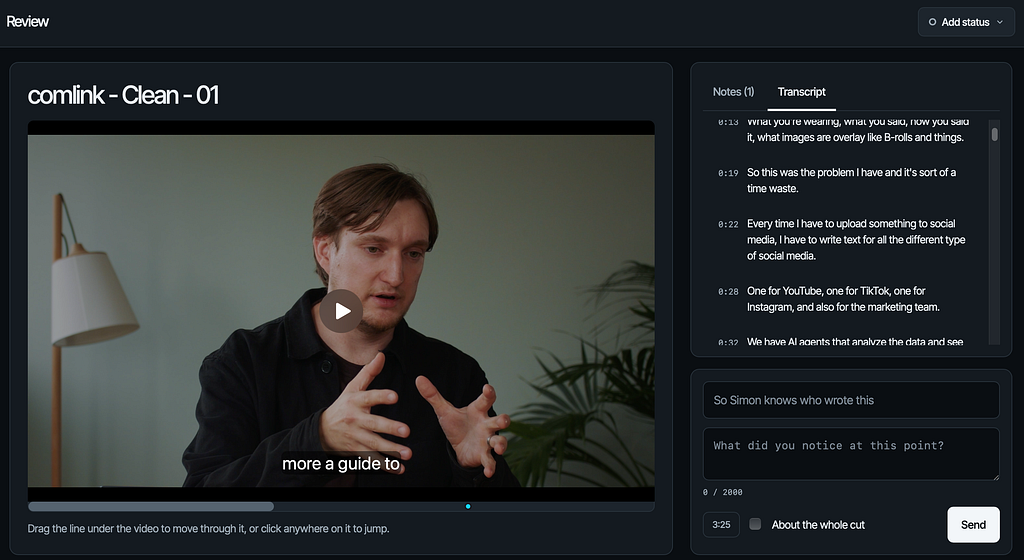
He had a problem a lot of people shipping video will recognize. Everything useful about a clip disappears the moment you export it. You plan the shoot, film it, edit it, hit export, and the file that comes out knows nothing about what you actually made. What you said. How you said it. What b-roll you cut in. What hook you opened on. All of that gets thrown away right when you need it most, because now you have to write captions for YouTube, TikTok and Instagram, and the marketing team’s analytics agents are stuck with a title and a thumbnail to work from.
So he closed that gap himself, using Claude and Open Source Cloud, in about a day. He filmed the whole build and put it up: “How I built a video publishing pipeline with Claude and OSC”.
What it actually does
Drop a finished video into a watch folder on your Mac. The rest happens on its own.
Under the hood it’s a chain of OSC services doing the parts he didn’t want to build from scratch:
- VideoCore converts the file into a shareable format and serves a review link that plays instantly over HLS, even on a bad connection.
- Whisper transcribes the audio to an SRT, with timecodes. That matters twice: once for the analysis, once for generating subtitles later.
- Frames get pulled from the video and analyzed alongside the audio, so the AI can describe the hook, the pacing, the structure, the tone, the delivery, the way a producer giving notes would.
- That analysis becomes draft copy for YouTube, TikTok and Instagram, written separately for each platform. If it reads too AI, he just tells it what he actually meant and it rewrites.
- A structured version of the same data gets pushed to a GitHub repo, so the marketing team’s analytics agents have something to work with beyond a title.
- Reviewers get a link with timestamped comments. Click one, jump straight to that moment in the clip.
- When it’s approved, one button publishes to the connected platforms. LinkedIn wasn’t wired up yet when he recorded this, and TikTok still needed some configuration, which he says on camera without dressing it up.
How he built it
He’s not an engineer. He says so directly in the video, and he’s clear that learning transcription, frame analysis and multi-platform publishing from scratch would cost him more time than the tool would ever save. So instead he connected Claude to Open Source Cloud through MCP, a few clicks under Settings and Connectors, and let each side do what it’s good at. Claude writes the app, OSC handles the infrastructure underneath it, so the AI has fewer chances to get the hard parts wrong.
From there it’s the same pattern our own AI dev team uses. Describe the goal, ask for an agent team (he set up a build agent, a security agent, a QA agent), give it one detailed prompt, and let it run overnight. It didn’t one-shot the whole thing. There was styling to fix and bugs to catch by testing the pipeline end to end. But getting this far after one overnight run, with no engineering background, is the point.
The clip analysis itself runs as a My Agent Task, a cloud Claude Code session with access to the repo and a clear brief on what to look for and how to format it. That’s the same primitive our engineering agents use for production work. There’s no separate version of this for consumers versus enterprises. It’s the same tool, pointed at a different job.
Why we’re calling this Agentic TV Operations
It would be easy to file this under handy internal tool and move on, but there’s a bigger point here.
We wrote about it last week, in a piece on why broadcasters shouldn’t spend an IBC budget on a new MAM when an agent with API access can do the same orchestration on request: Going to IBC to Procure a New MAM? Read This First. The line from that piece: “TV operations is heading where software already went, agents doing the orchestration and not just the code.” The examples there were operational: one sentence gets a large file in front of a reviewer as a playable HLS link, no uploading or compressing required. Ask an agent to collect every clip tagged “goal” into a new set, and it does. That’s the same review-link mechanism VideoCore is doing here, just pointed at a marketing clip instead of a broadcast asset.
Agentic TV Operations names a specific gap: an AI can write software fairly easily now, but getting that software to actually run in production, on real infrastructure, is where most of these projects stall. Our engineering team closed that gap once already, building Open Source Cloud itself. The MAM piece showed it on the operations side. This is the same pattern again, one department over, solving a problem that had nothing to do with infrastructure and everything to do with a marketer’s Tuesday.
If you run marketing, promo or social for a TV station or streaming service, you likely have the same gap. A promo team cutting sizzle reels and social clips. Metadata that disappears at export. Captions written by hand for five platforms. An analytics dashboard that only sees a title and a runtime because nothing richer was ever captured upstream. None of that needs a dev team or a procurement process to fix anymore. It needs someone who understands the problem, usually not the engineer, sitting down with an AI agent and infrastructure that stays out of the way.
He said he’s going to run every video he makes through this pipeline from now on. That’s the part that matters: not that it worked once, but that he’s actually going to keep using it. The full build, including the parts where it broke, is in the video above.
We’ll be walking the floors at IBC 2026. If you want to keep talking about this, find Jonas Birmé, Magnus Svensson, Alexander Björneheim or Boris Asadanin.