
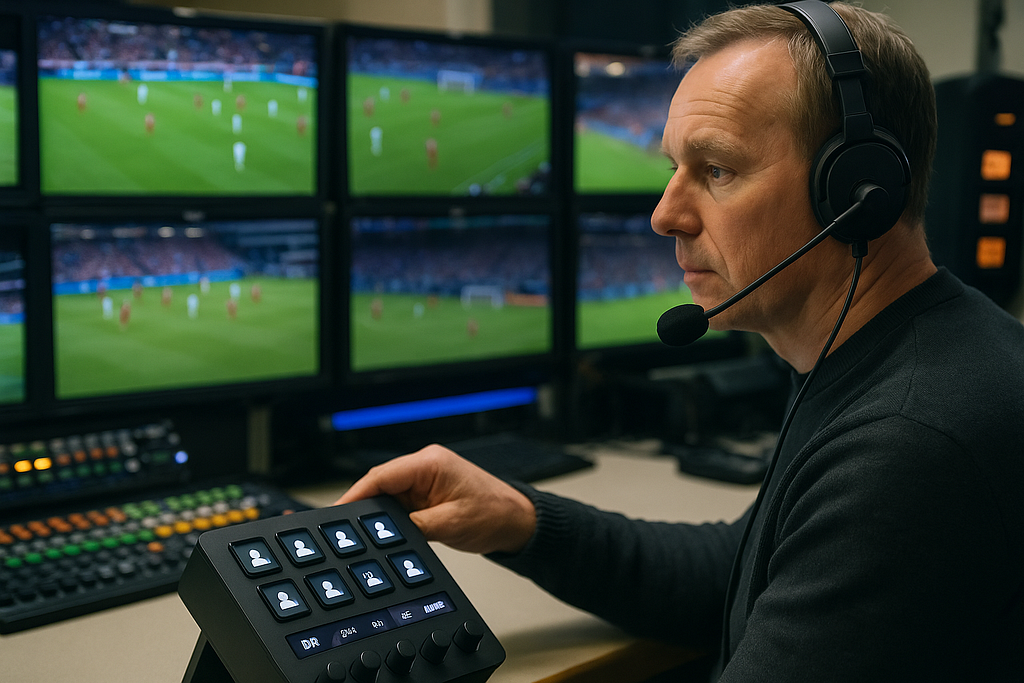
During a sports production event, an insightful conversation raised a simple but powerful question: Why are we still tied to complex, proprietary intercom systems when modern, open-source technologies could offer simpler, more flexible alternatives?
That question didn’t just fade away, it sparked action. It led to a unique cooperation between SVT, YLE, NRK, TV2 Norge, and Eyevinn Technology to reimagine intercom systems for live broadcast production.
A New Kind of Collaboration
This initiative stands out not just for its technical innovation, but for its collaborative model. Rather than waiting for traditional vendors to adapt or respond, the broadcasters chose to act. Together, they pooled resources and expertise to form a shared innovation initiative with Eyevinn Technology, a media software specialist known for its forward-thinking engineers and deep understanding of broadcast workflows.
This wasn’t a typical vendor-client relationship. It was a true partnership where:
- Broadcasters brought real-world needs and operational insights from their production teams.
- Eyevinn Technology brought modern software engineering skills, open-source know-how, and a passion for challenging the status quo.
This blend of domain knowledge and engineering excellence created a foundation for innovation tailored to actual user needs.
From Challenge to Proof of Concept
The working model was lean and pragmatic. First, the problem was clearly framed: proprietary intercom systems were too rigid, expensive, and confusing for newer generations of production staff. There was a desire to shift from hardware-dependent, legacy systems to software-first solutions aligned with the needs of digital-native production teams.
To test this ambition, the group quickly scoped and developed a Proof of Concept (PoC). The goal was simple: show that a modern, WebRTC-based intercom system could replicate, and improve upon, traditional intercom functionality while remaining intuitive and cost-effective.
The PoC used open standards and cutting-edge technologies, including:
- WebRTC for real-time browser-based communication
- RESTful APIs to manage the WebRTC media service (Symphony Media Bridge) for media routing
- A simple, browser-based front-end interface accessible on various devices, including mobile phones
The result? The concept worked, and it worked well. Even during the early tests, the user feedback was overwhelmingly positive, especially regarding ease of use, responsiveness, and the flexibility to adapt to different production environments.
Agile Development Meets Organizational Transformation
With a successful PoC in hand, the team didn’t pause, they accelerated. Development continued using agile methodologies, with iterative sprints, user feedback loops, and continuous testing in live environments. This allowed for rapid evolution of features and interface improvements, ensuring that the final product stayed grounded in real-world needs.
Crucially, this was more than a technology shift — it was a transformation process.
- Broadcasters were not just passive users. They were active participants in design reviews, sprint demos, and decision-making sessions.
- Engineering and production teams worked side-by-side, ensuring that the technical direction was always aligned with operational reality.
- Change management was built-in: the solution was introduced progressively, training and workflows were adapted gradually, and adoption was organic rather than forced.
By bringing users into the development process, the transition to the new intercom system became an enabler of cultural change. Production teams became more confident and self-reliant, no longer dependent on specialized technicians to manage communication systems. The familiar tools, push-to-talk, headset integration, channel selection, were still there, but now accessible via a streamlined web interface that “just works.”
Live Today, and Ready for Tomorrow
This open-source intercom system is no longer a prototype. It’s now in active use in live television production — delivering the scalability, simplicity, and reliability that modern broadcasters demand.
You can read more about its real-world implementation here: Modern Broadcasting Transformed
A Blueprint for Future Innovation
This initiative offers a blueprint for how modern broadcasting challenges can — and should — be solved:
- Start with user needs, not vendor roadmaps.
- Move fast with proofs of concept that reduce risk and validate direction.
- Collaborate across boundaries between broadcasters and software experts.
- Iterate and scale, all while supporting organizational change.
At Eyevinn, we believe this model, open, agile, and collaborative, is the future of media technology development. The success of this intercom project shows that when the right minds come together with shared purpose and clear focus, transformation doesn’t just happen. It accelerates.
Eyevinn Technology remains committed to driving innovation in broadcast and media solutions. For more information or enterprise support, contact sales@eyevinn.se.